
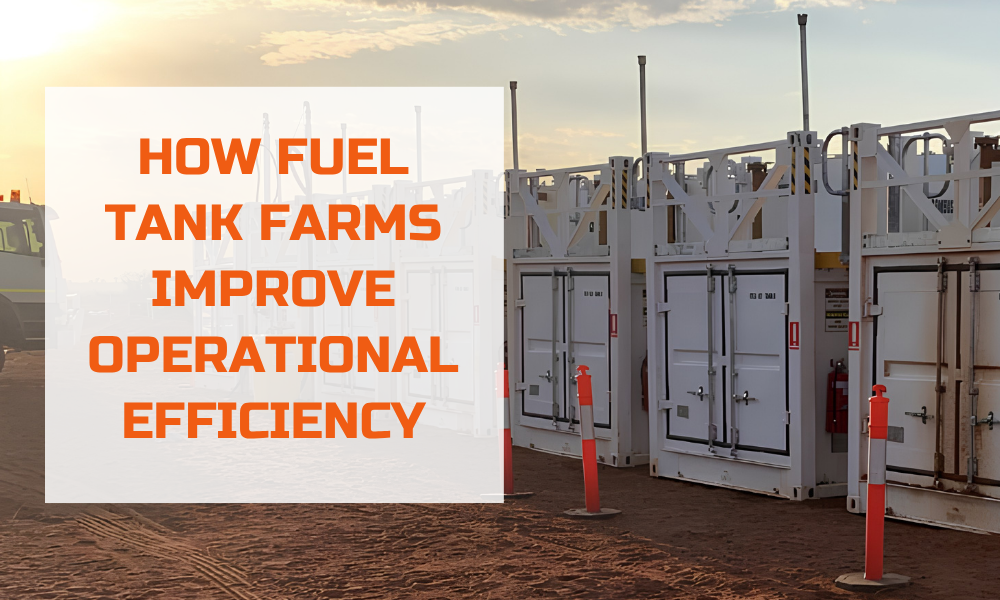
Large industrial facilities can consume substantial quantities of fuel. Managing multiple individual fuel tanks can become inefficient, particularly when generators, vehicles, and heavy machinery operate across a large site. Fuel tank farms provide a centralised approach to storing and distributing fuel.
Centralised Fuel Storage
A fuel tank farm brings storage capacity together in a planned location. Instead of maintaining several independent tanks, businesses can manage fuel through a centralised system.
This can simplify fuel monitoring, deliveries, and distribution.
Improving Fuel Availability
Fuel shortages can interrupt industrial operations. A centralised storage system makes it easier to monitor inventory and determine when replenishment is required.
Businesses can establish delivery schedules based on actual consumption rather than reacting to unexpected shortages.
Supporting Multiple Generators
Industrial facilities may operate several generators simultaneously. A properly designed fuel system can support multiple units and simplify refuelling arrangements.
This can be particularly useful for remote sites where fuel deliveries require significant planning.
Better Inventory Management
Centralised storage can make fuel consumption easier to track. Businesses can monitor how much fuel is being stored, delivered and consumed.
Accurate information can support budgeting, purchasing decisions and operational planning.
Reducing Manual Handling
Where appropriate, fuel distribution systems can reduce the need for workers to repeatedly transport fuel between storage points and equipment.
Reducing unnecessary manual handling can also support safer site operations.
Environmental Protection
Fuel tank farms require careful design because large quantities of fuel may be stored in one location. Appropriate containment, tank selection, monitoring and emergency procedures are important.
The installation should be designed to address relevant environmental, safety and regulatory requirements.
Maintenance and Inspection
Centralised fuel infrastructure should be inspected and maintained regularly. Tanks, pumps, pipes, valves and associated equipment can deteriorate over time.
Early identification of leaks, corrosion or equipment faults can prevent larger operational and environmental problems.
Conclusion
Fuel tank farms can improve operational efficiency by centralising storage, simplifying inventory management and supporting reliable fuel distribution. For businesses with substantial fuel requirements, professional design and appropriate maintenance are essential to achieve these benefits safely.
FAQs
- What is a fuel tank farm?
It is a centralised installation containing one or more fuel storage tanks and associated distribution equipment. - Which businesses can benefit from fuel tank farms?
They can be useful for mining, construction, power generation, transport, and other fuel-intensive industrial operations. - Can one tank farm supply multiple generators?
Yes, a properly designed system can distribute fuel to multiple generators or equipment. - Do fuel tank farms require containment?
Appropriate containment and environmental controls may be required depending on the installation and applicable requirements. - How does centralised storage improve efficiency?
It can simplify fuel monitoring, deliveries, distribution, and inventory management.