
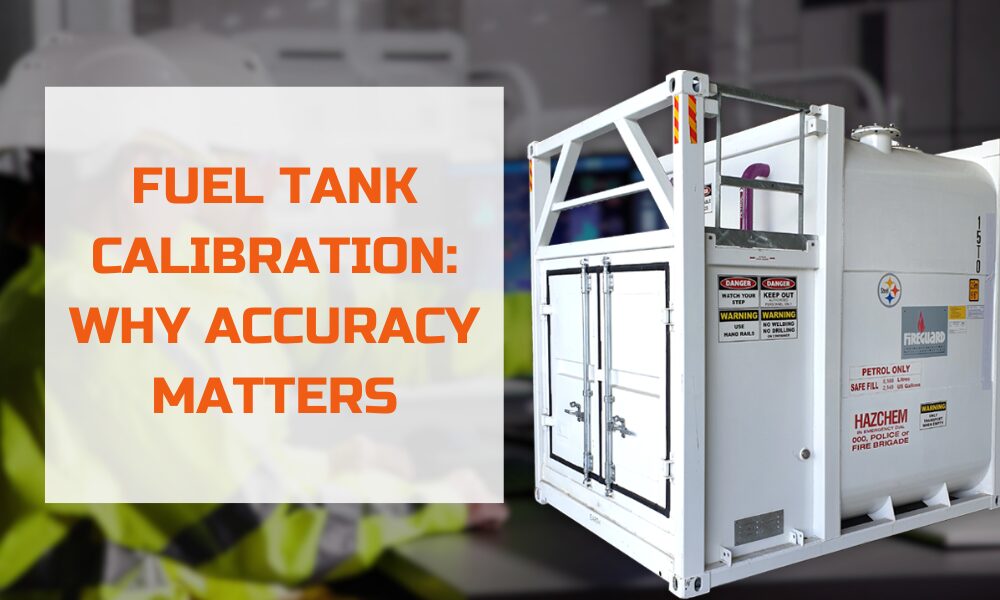
Fuel is one of the highest operating costs for any business that relies on diesel, from mining and construction to transport and agriculture. Yet many operators have no reliable way of knowing exactly how much fuel is sitting in their tanks at any given moment. That’s where Fuel Tank Calibration comes in. By accurately mapping a tank’s true volume against its gauge or dip readings, calibration turns guesswork into hard data, and on a busy site across Western Australia, that accuracy can be worth a great deal. Here’s why it matters and what a proper calibration involves.
What is fuel tank calibration?
Fuel Tank Calibration is the process of precisely measuring the internal volume of a storage tank and creating a reference chart, or “dip chart”, that converts a measured depth of fuel into an exact quantity in litres. No two tanks are identical: manufacturing tolerances, dents, tilt on uneven ground, and internal fittings all affect how much fuel a tank actually holds at a given level. Calibration accounts for these real-world variations, so the number on your gauge or dipstick genuinely reflects what’s in the tank.
Why is accuracy so important?
An inaccurate tank reading might only be out by a few per cent, but across thousands of litres and repeated deliveries, small errors add up fast. If you think you’re receiving a full delivery but you’re consistently a little short, you’re paying for fuel you never got. If your inventory figures are wrong, you can’t reconcile usage, budget accurately or spot a developing problem. Accurate Fuel Tank Calibration gives you confidence that every litre is accounted for, from delivery through to consumption.
Detecting theft, leaks and losses
Fuel theft and unexplained losses are a genuine and costly problem on remote and unsecured sites. Without accurate baseline measurements, a slow leak or ongoing pilferage can go unnoticed for months. When your tank is properly calibrated, you can reconcile fuel in against fuel out with real precision, so any discrepancy shows up quickly. That early warning lets you investigate a leak before it becomes an environmental incident, or shut down theft before the losses mount up.
Better inventory and cost control
Reliable fuel data underpins good decision-making. Accurate readings let you track consumption by machine, shift, or project, forecast reordering so you never run dry, and negotiate deliveries with confidence. For operations running multiple generators, vehicles or plants, precise calibration transforms fuel from a rough estimate into a measurable, manageable cost. Over a full financial year, tighter control over fuel inventory can translate into substantial savings.
Compliance and accurate reporting
Many industries face reporting obligations around fuel usage, emissions and, in some cases, fuel tax credits. Accurate measurement is the foundation of accurate reporting. Calibrated tanks help you meet record-keeping requirements, support fuel tax credit claims with defensible data, and demonstrate proper stewardship of stored fuel. When auditors or regulators ask how you know your figures are correct, a professional calibration certificate is a straightforward answer.
What a professional calibration involves
Proper Fuel Tank Calibration is a technical job best left to qualified specialists. The process typically involves measuring the tank’s dimensions and geometry, accounting for its orientation and any tilt, and either physically metering known volumes into the tank or using precise volumetric calculations to build the reference chart. The result is a calibration chart matched to your specific tank, often accompanied by a certificate. Recalibration is recommended periodically and after any event that could alter the tank’s shape or position, such as relocation, modification, or damage.
When you should calibrate
Calibration isn’t a one-off. It’s worth calibrating a new tank before it goes into service, rechecking existing tanks that have never been properly calibrated, and recalibrating after a tank is moved, repaired, or modified. Sites with high fuel throughput, valuable inventory, or strict reporting obligations benefit most from keeping their calibration current. If you can’t confidently say how accurate your tank readings are, it’s a sign that a calibration is overdue.
The bottom line
Fuel is too valuable to manage by guesswork. Accurate Fuel Tank Calibration protects you against short deliveries, theft and undetected leaks, sharpens your inventory and cost control, and keeps your reporting defensible. It’s a small, sensible investment that pays for itself through the fuel it helps you protect and the losses it helps you avoid.
If you’d like precise, professional calibration for your storage tanks, the team at GHASA can measure, calibrate, and certify your equipment so you always know exactly what’s in your tank.
Frequently Asked Questions
- What is fuel tank calibration?
Fuel Tank Calibration is the process of accurately measuring a tank’s true internal volume and producing a reference chart that converts a measured fuel depth into an exact quantity in litres. It ensures your gauge or dipstick readings reflect the real amount of fuel in the tank. - Why is accurate fuel measurement important?
Even small measurement errors add up across thousands of litres, leading to paying for fuel you didn’t receive, inaccurate inventory, and undetected losses. Accurate calibration lets you reconcile fuel in and out, control costs, and catch leaks or theft early. - How often should a fuel tank be calibrated?
Calibrate a new tank before it enters service, and recalibrate periodically or whenever a tank is moved, repaired, modified, or damaged, as any of these can change its true volume. High-throughput sites and those with strict reporting should keep calibration current. - Can fuel tank calibration help detect theft or leaks?
Yes. With an accurately calibrated tank you can reconcile fuel deliveries against usage precisely, so any unexplained discrepancy stands out quickly. This makes it far easier to identify a slow leak or ongoing theft before losses become significant. - Do I need a professional to calibrate my fuel tank?
Yes. Accurate Fuel Tank Calibration requires specialist knowledge and equipment to account for tank geometry, tilt, and fittings. A qualified technician produces a reliable calibration chart and certificate you can trust for inventory, compliance, and reporting.